
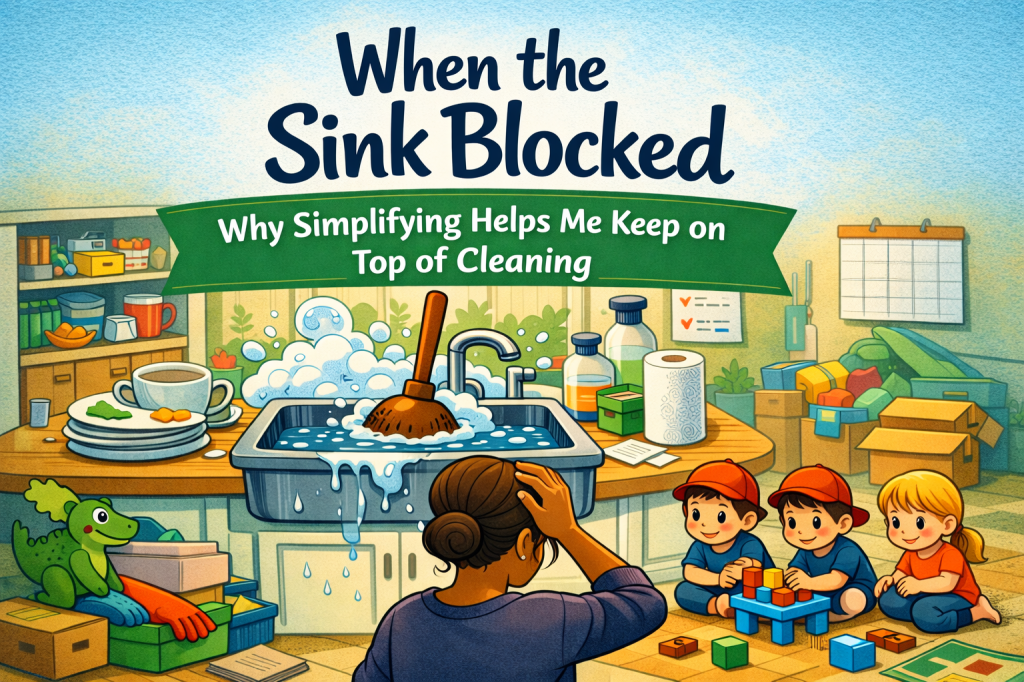
The sink blocked on a day that already felt full.
This time, it wasn’t something I could fix quickly. A communal blockage caused water to overflow back into the kitchen, turning a normal morning into damage control.
Breakfast needed doing. Dishes were waiting. And suddenly, something as basic as running the sink wasn’t possible.
Everything felt harder.
Not because the problem was dramatic, but because there was no space for it.
Cleaning still matters to me. Simplifying hasn’t replaced it. It’s what makes it manageable when life is full.
How Small Home Problems Create Big Stress
A blocked sink shouldn’t feel overwhelming. But when it’s out of your control, and capacity is already low, small home issues quickly become heavy.
As I moved around trying to contain the overflow, I started noticing the rooms around me.
Cupboards that were fuller than they needed to be.
Drawers I avoided opening properly.
Items kept “just in case” that quietly take up space and attention.
The blockage didn’t create stress. It revealed it.
When homes are full, disruptions land harder. There’s less flexibility, less margin, and less emotional space to absorb the unexpected.
Why Simplifying Supports Cleaning, Not Replaces It
I’m not trying to create a minimal home for the sake of it. I’m trying to create a home that copes, even when things go wrong beyond my control.
When there’s less stuff:
- cleaning takes less effort
- problems stay smaller
- decision-making is reduced
- routines recover more quickly
Simplifying doesn’t mean cleaning less. It means cleaning is easier to keep on top of, even during disruption.
The communal blockage made that obvious. When systems fail, the environment either helps you cope or adds to the strain.
Rethinking How I Spend Money on the Home
That moment also made me pause on spending.
Not in a restrictive way, but a more intentional one.
Do we need more things, or better systems?
Does this purchase support daily maintenance, or add to it?
Am I buying convenience, comfort, or clutter?
Simplifying a home isn’t just about decluttering. It’s about being thoughtful before adding more, especially when children are involved and things multiply quickly.
The Moment That Stayed With Me
While I was dealing with the overflow, the children carried on.
They weren’t bothered by the disruption. They adapted without comment. The situation that felt overwhelming to me barely registered for them.
That moment stayed with me.
The stress wasn’t shared. It was carried quietly.
Much of what overwhelms us as adults lives in the background: the maintenance, the mental lists, the responsibility for when things stop working.
Simplifying my home isn’t about control. It’s about support.
Creating a Home That Supports Real Life
I want rooms that are easier to reset.
Spaces that don’t require constant management.
Systems that hold together when something goes wrong.
Less stuff doesn’t mean less life.
For me, it means more breathing room.
The communal blockage was inconvenient. But it was also clarifying.
Sometimes it takes an external failure to show you where your environment could be lighter.
A Moment to Reflect
When something in your home stops working, what makes it harder than it needs to be?
And what might be ready to go, simply to make everyday cleaning and coping a little easier?
Signed L.
 Raising Three, Rebuilding Me
Leave a comment