
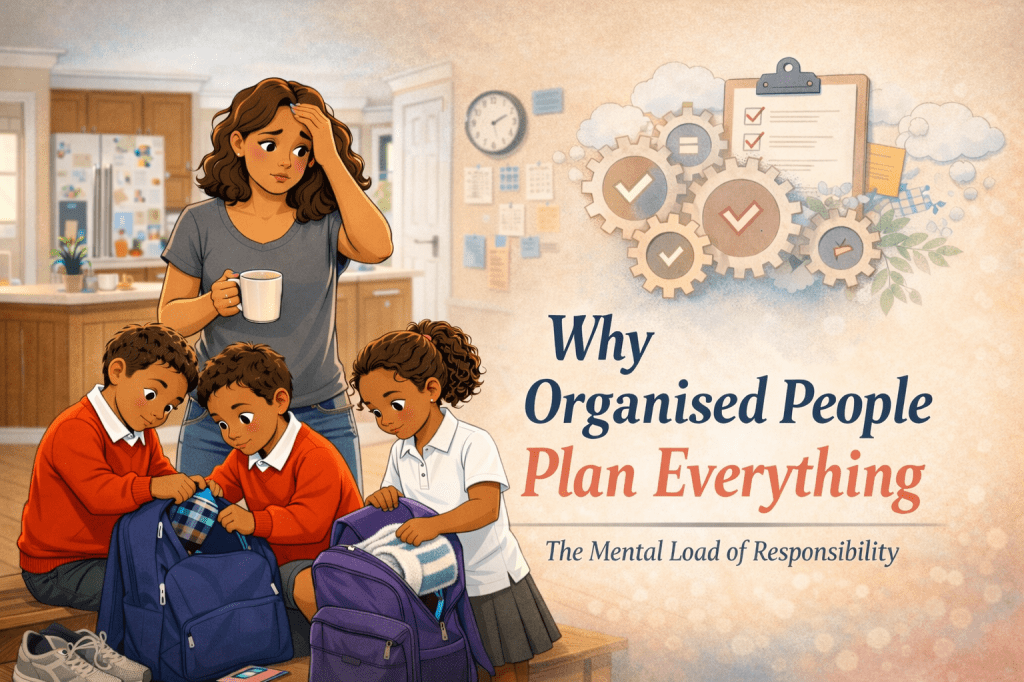
People often joke about “the organised one.”
The person with lists.
The one who plans three steps ahead.
The one who already has a backup plan.
Sometimes it’s said with admiration.
Sometimes with a little amusement.
But for many of us, organisation is not just a personality trait.
It’s a coping strategy.
And psychology research suggests there may be a reason why some people naturally think this way.
The Mental Load: The Invisible Work of Responsibility
Psychologists often use the term mental load to describe the invisible thinking work required to manage a household and anticipate needs.
Mental load includes things like:
- remembering school events
- planning meals
- scheduling appointments
- anticipating problems before they happen
- managing children’s emotional needs
Unlike physical tasks, mental load happens quietly inside the mind.
And studies show that parents, particularly mothers, often carry a significant portion of this cognitive responsibility.
You’re not just planning a day.
You’re carrying the emotional and practical weight of a family.
The Psychology of Planning Ahead
In psychology, researchers sometimes refer to this ability as planfulness.
Planfulness is the ability to think ahead, anticipate challenges, and prepare for multiple possible outcomes.
Research suggests that people with strong planning tendencies often experience:
- better emotional regulation
- greater goal achievement
- reduced stress when facing uncertainty
Planning helps the brain reduce anxiety by turning unknown situations into manageable ones.
In simple terms, thinking ahead gives the mind a sense of safety.
Plan A, Plan B, and Sometimes Plan C
If I’m honest, I am that person.
Plan A.
Plan B.
Sometimes Plan C.
To some people, it might look like overthinking.
But for me, it’s how I function.
Because when you are responsible for young children, life rarely follows a straight line.
You start thinking about possibilities automatically.
What if someone gets sick?
What if plans change?
What if something doesn’t go as expected?
Planning helps reduce surprises.
And fewer surprises mean a calmer mind.
Why Responsibility Changes the Way You Think
When people depend on you, your brain naturally shifts into anticipatory thinking.
Anticipatory thinking is the mind’s ability to imagine possible future situations so you can prepare for them.
Parents use this constantly.
You begin scanning for risks, preparing solutions, and adjusting plans before problems appear.
It is not anxiety.
It is responsibility.
And over time, it becomes second nature.
Organisation Is Not About Control
One misconception about organised people is that they want to control everything.
But often, the opposite is true.
Planning isn’t about perfection.
It’s about reducing the emotional burden of uncertainty.
When things are written down, scheduled, and thought through, your mind doesn’t have to hold everything at once.
Plans aren’t cages.
They are safety nets.
They give you flexibility when life inevitably shifts.
Planning as Peace of Mind
For me, organisation brings peace.
When I have a plan, I can breathe.
It doesn’t mean everything will go perfectly. It simply means I’m prepared enough to adapt when things change.
And when you’re raising young children, that preparation matters.
Because the truth is, planning is not just about productivity.
Sometimes it’s about protecting your peace.
A Question to Reflect On
Are you someone who plans everything because you love control?
Or because you carry responsibility?
And what would change if people understood that organisation is often not about perfection…
…but about protecting your peace?
Research & Sources
This article draws on research exploring the mental load of parenting, cognitive labour, and the psychology of planning.
Daminger, A. (2019). The cognitive dimension of household labor. American Sociological Review.
Dean, L., Churchill, B., & Ruppanner, L. (2021). The mental load: Building a deeper theoretical understanding of how cognitive labour shapes women’s lives. Work, Employment and Society.
Offer, S. (2014). The costs of thinking about work and family: Mental labor, work–family spillover, and gender inequality. Sociological Forum.
Ludwig, R. et al. (2023). Planfulness and Goal Achievement.
UCLA Health. Understanding the Mental Load in Parenting.
 Raising Three, Rebuilding Me
Leave a comment